The Long and Winding Road
There is a roundabout on the way home where, on certain evenings, a man turns left instead of right. Nobody knows he has done it, and he is neither lost nor avoiding anyone. He is doing something sensible, and this article is an attempt to explain what.

Yes, I know where the title comes from. No, I won't be singing it.
But perhaps you'll know the moment. For some reason you just fancy taking the long route home. So for the next twenty minutes you take a road that adds twenty minutes to the journey. This is not a quirk. It is, I think, one of the more reliable psychological habits men have, and almost none of them have been told that. They'd maybe describe it as "needing to clear my head" or "just fancied the drive," and move on. The car has been quietly doing a job for men for many decades.
Fifteen minutes alone
In 2014, a team led by psychologist Timothy Wilson at the University of Virginia published a set of experiments you've probably never heard of. Participants were asked to sit alone in a bare room for up to fifteen minutes with nothing to do but think. No phone, no book, no pen. In one version, they had first been given a mild electric shock and asked whether they'd pay to avoid experiencing it again. Those who said they would were then left in the room with a button that would deliver the shock.
Two-thirds of the men chose to shock themselves at least once rather than sit quietly with their own thoughts. Among the women, it was about a quarter.
I wouldn't hang too much on that single gender comparison. But the broader finding, replicated across several of the experiments, is that most people find unstructured time alone with their own thoughts surprisingly hard to tolerate, and that men seem to find it harder still.
I don't view that as men being unable to think. I read it as thinking with no task attached being oddly uncomfortable, partly because most of us haven't practised it since roughly the mid-nineties, and partly because, as the article on alexithymia explains, a good number of men are not entirely sure what they'll find when they look. A mind left completely alone will go wherever it likes, and it doesn't always go somewhere cheerful.
Which brings us to the car.
Why the car works where the armchair doesn't
The trick, I'd suggest, is that driving gives the mind a small job.
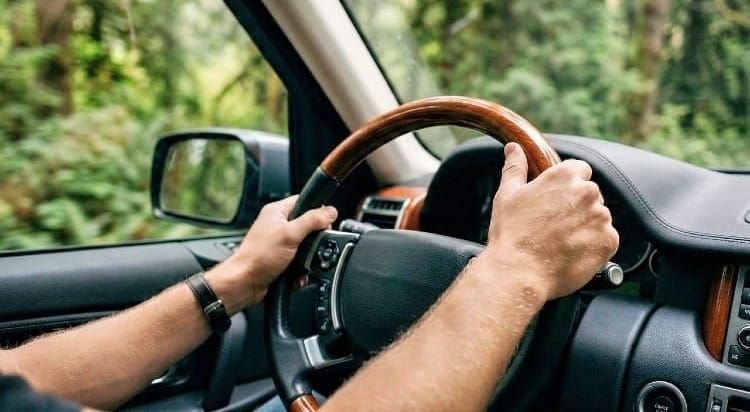
Driving along a familiar road is about the least demanding skilled task most of us ever perform. It occupies the hands, the eyes and the part of the brain that needs something to fiddle with, and it leaves the rest of the mind free to wander. That is a very particular condition, and it's hard to reproduce on a sofa.
A quiet road is a real-world version of an undemanding task. It's also why so many men report that the answer to the thing they'd been chewing on all week turned up somewhere around the second set of traffic lights, having evidently been working on it without telling anyone.
There's a further reason, which has to do with the landscape sliding past the window. The attention restoration research, which came up in the articles on in defence of the shed and man and dog, describes something called soft fascination: gentle, effortless interest in moving scenery, trees, sky, the shape of a hill. It engages attention without draining it. A quiet A-road delivers this generously. The M25 at twenty to six does not, and restores nothing but irritation, which is another story and is covered rather thoroughly in my article on why your patience has left the building.
Side by side, again
The car has one more structural advantage, and it will be familiar to anyone who has ever driven a teenager anywhere.
Teenagers will say things in a car that they would never say at a kitchen table, even if you paid them. The reason is the same one that runs through the articles on why male friendship is harder to maintain after 40 and why men who fix things are onto something psychologically. Side-by-side conversation, with both parties looking at something else, is lower pressure than face-to-face. Nobody has to perform an expression. The silences are covered by road noise and visual distractions. An awkward sentence can be said to a windscreen, then allowed to be processed at its own pace.
Men have always known this instinctively. A good deal of the most honest conversation between fathers and sons, and between old friends, has happened at forty miles an hour with neither of them looking at the other. The car becomes a confessional but with the added benefit of a heater.
The airlock
Occupational psychologists use the term psychological detachment to describe the ability to mentally switch off from work during non-work time, and it is one of the better predictors of whether people recover from a demanding job or slowly burn down. Detachment doesn't happen on command. It needs a transition, some way of leaving one role and entering another, and yes, the journey home, whether by car, bus, train or walking, has quietly served as that for generations. Think of it as an airlock between two pressures.
Men who now work from home often discover that the airlock has gone. The laptop closes, and the man is simply, abruptly, in the kitchen, still carrying the afternoon. And as the article on burnout described, the man who sits in the parked car outside his own house for a few minutes before going in is often doing this by instinct, buying back the transition that the day denied him. Far from being strange, that is the airlock operating at the last possible moment.
Aimless, but on purpose
I like the phrase purposeful aimlessness. It sounds like a contradiction, and it is, but it's a useful one.
The aimlessness is that you have no destination. The purpose is that you've chosen to do it to give your mind some room.
The mind wandering that happens in these conditions is not the same as the 2 am replay described in the article on rumination. That is a loop: the same material retrieved and replayed, going nowhere. A drive moves, and the thinking tends to move with it. Problems rearrange. Half-formed decisions become slightly more formed. Something you'd been avoiding for a fortnight turns out, at fifty miles an hour, to be considerably less alarming than it was at the desk. The default network of the brain, the system that switches on when you're not focused on any external task and does the work of making sense of experience, finally gets the quiet it needs to get on with it.
The distinction that matters is the one from the article on why men withdraw: retreat versus avoidance. A retreat is chosen, bounded, restorative, and ends with a return. An avoidance is a way of not going home. The test is simple. Do you come back from the drive more available than you left, or is it a way of postponing something indefinitely? Tell the people at home you'll be twenty minutes late and the question mostly answers itself.
What the car has become
I still drive an old Land Rover. Its one concession to modernity is heated seats. By contrast my friend has a Mercedes which is built like a tank and, to my mind, is more like a rolling notification centre. The touchscreen wants your attention. The phone wants to connect itself to the touchscreen. The dashboard has opinions about your lane position, your following distance and possibly even your tiredness. A call arrives through the speakers whether you want it or not. The airlock now has a doorbell.
And yes, I'm aware that I make a podcast. Listen to it (please) in the car by all means. Just not on every journey.
The article on my tech, my rules made the case that men in the second half of life tend to be deliberate about which technology they allow into their lives. The car is the place to apply that principle with some force. If it can be silenced, silence it. A thinking space only works if nobody else is in it.
Where the car stops being the answer
Sorry if this sounds a bit preachy, but:
Safety comes first. A drifting mind on an undemanding road is a pleasure. A mind so far away that you miss the junction is a hazard. This is an argument for the thinking drive, not for zoning out in the outside lane. If your thoughts become absorbing enough to compromise your attention, pull over.
If the car is the only place you ever feel like yourself, or if you notice you're dreading the front door, that is information.
If the thoughts that arrive when you're alone are dark, don't carry them around the ring road. Pull over and stop, and talk to someone. A doctor is the right first conversation, and the Samaritans are on 116 123, at any hour.
Thoughts on this?
I'd love to read your comments. You will need to subscribe, but them's the rules, and you won't be hassled.