The Case for Birdwatching — Seriously!
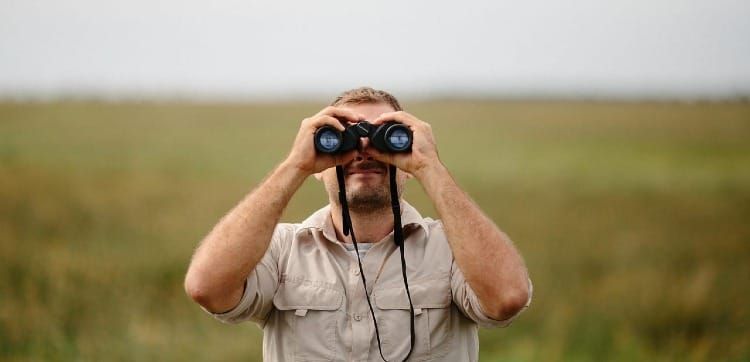
Birdwatching has an image problem. It is associated, in the popular imagination, with a specific type of person standing in a field in waterproof clothing, writing something in a notebook, apparently content. This article is an argument that the 'apparent content' part is not a coincidence.

Let's deal with the image problem first, because it is real and it needs addressing before the evidence can be presented to a sceptical audience.
Birdwatching — or birding, as its more serious practitioners prefer, on the grounds that watching is what amateurs do and birding is what people who actually know what they're looking at do — has, for reasons that are not entirely explicable, acquired a reputation as the hobby of retired vicars, mild eccentrics and people who find the pace of fishing too frenetic. It is the subject of gentle mockery in a way that golf, which involves hitting a small ball into a hole repeatedly for four hours at considerable expense, is not. It is considered, in some quarters, not quite a proper activity for men who have other options.
This reputation is both unfair and increasingly difficult to sustain against the evidence. Birdwatching, in the UK at least, has approximately one million active participants, making it one of the most widely practised outdoor activities in the country. Its demographics skew older and male in proportions that suggest it is doing something right for the specific audience this site addresses. And the research on its psychological benefits — which has been accumulating with a quiet persistence that mirrors the activity itself — makes a case that is considerably more compelling than its cultural reputation would suggest.
The attention restoration angle
The most direct route into the psychology of birdwatching runs through the Attention Restoration Theory described in my article on in defence of the shed — the Kaplans' framework for how certain environments restore the directed attention depleted by modern working and domestic life.
Birdwatching engages what the Kaplans called soft fascination — the effortless, low-demand attention that natural environments and their inhabitants produce — in a particularly concentrated form. The bird in the hedge, the movement at the periphery of vision, the sound that suggests something worth investigating — these engage involuntary attention without demanding the directed cognitive effort that depletes it. The brain is occupied and interested without being taxed.
The restorative effect of this engagement is not subtle. A 2017 study published in Bioscience, drawing on data from the EPSRC-funded Fragments project at the University of Exeter, found that higher numbers of birds in the immediate environment were associated with lower levels of depression, anxiety and stress — an effect that persisted after controlling for income, age, and other socioeconomic variables. The birds were not incidental to the wellbeing benefit. They were its mechanism.
A subsequent study from the same research group, published in Scientific Reports in 2022 and covering data from 1,300 participants across multiple countries, found that encounters with birds in everyday settings produced measurable improvements in mental wellbeing lasting up to eight hours. Not the eight hours of someone who had spent the morning at a nature reserve with specialist equipment — the eight hours of someone who had noticed a bird in their garden or on their walk to work.
This is worth sitting with for a moment. Eight hours of improved wellbeing from noticing a bird. The pharmaceutical industry, which spends billions developing compounds that produce measurable mood improvement for comparable durations, has not managed to make this sound less remarkable by comparison.
The mindfulness you'll actually do
Mindfulness — the practice of deliberate present-moment attention — has a substantial evidence base for reducing anxiety, managing depression and improving psychological wellbeing. It also has a substantial dropout rate among the men who are theoretically its most likely beneficiaries, because sitting quietly focusing on your breathing while your mind catalogues everything else you should be doing turns out, for many men, to be considerably harder in practice than in theory.
Birdwatching is, in its functional psychological mechanism, mindfulness conducted outdoors with a more compelling object of attention than the breath.
The birder in the field is, by operational necessity, in the present moment. The bird is there now or it isn't. The identification requires attention to the details of the present encounter — the field marks, the behaviour, the song — that cannot be achieved while simultaneously rehearsing tomorrow's concerns. The rumination that characterises anxiety and depression is directly incompatible with the attentional demands of watching a bird closely enough to identify it.
This is not a therapeutic claim being retrofitted onto a leisure activity. It is a description of the attentional mechanism that birdwatching requires, and it is why the men who practise it report what they report: a quality of absorption in the present moment that ordinary leisure activities — the television, the pub, the scroll through the phone — do not produce.
The University of Derby's research on nature connectedness, led by Miles Richardson, has consistently found that engagement with nature — and specifically the kind of attentive, curious engagement that birdwatching involves — produces psychological wellbeing improvements that generic time outdoors doesn't replicate. The attention to the specific — to this bird, in this tree, doing this thing — matters. The attentiveness is the mechanism.
Birdwatching is the mindfulness that men who would never sit quietly focusing on their breathing will actually do, because it gives the attention something worth attending to. The bird doesn't know it's providing a psychological service. It doesn't need to.
The outdoor dimension
The psychological and physiological benefits of time outdoors are well-established — reduced cortisol, improved immune function, the restorative effects of natural environments on directed attention, and the documented association between green space and reduced rates of depression and anxiety.
Birdwatching is, among other things, a reliable mechanism for getting men outdoors who would not otherwise be outdoors, or not outdoors in the sustained, attentive way that produces these benefits, rather than the transit-oriented way of a man getting from one indoor environment to another.
The specific quality of outdoor engagement that birdwatching produces is worth distinguishing from generic outdoor time. The birder is not walking through a park while listening to a podcast and thinking about something else. He is present in the environment with the attentiveness that the activity requires — alert to sound, to movement, to the specific characteristics of the habitat and what they imply about what might be found there. This quality of engaged presence in a natural environment produces the full range of psychological benefits that outdoor time can provide, rather than the partial benefits of physically outdoor but cognitively absent activity.
The physical dimension is not negligible either. Birding in the UK involves, for those who take it seriously, considerable walking across varied terrain in weather that does not always cooperate. The cardiovascular benefits of the exercise are real, and the combination of aerobic activity, natural environment and attentive engagement produces a compound effect on mood and cognitive function that each component alone would not replicate.
The learning dimension
Birdwatching is a pursuit with an essentially infinite learning gradient. There is no point at which a birder has learned everything there is to know — about identification, about behaviour, about ecology, about song, about the migratory patterns that bring different species through different habitats at different times of year.
This is not accidental. It is one of the structural features that makes birdwatching — along with other natural history pursuits — particularly well suited to the cognitive needs of retirement. The retired professional who has spent forty years building expertise in a specific domain finds, in serious birdwatching, a domain that rewards the same kind of systematic, accumulated knowledge-building that professional life provided — with the significant advantage that the knowledge base never stops expanding, the field is never mastered, and there is always something new to learn.
The cognitive demands of bird identification, specifically discriminating between genuinely similar species, learning the field marks that distinguish them, developing the ear for song that experienced birders use as readily as visual identification, engage the pattern recognition, auditory processing and sustained attention that the brain in later life particularly benefits from exercising. These are not trivial cognitive tasks. The man who can identify thirty warblers by song has built a cognitive infrastructure that represents genuine, hard-won expertise.
The Royal Society for the Protection of Birds — the primary UK birdwatching organisation, with over one million members and local groups across the country — provides structured resources for learning at every level, from complete beginner to experienced birder. The British Trust for Ornithology provides opportunities for involvement in citizen science — the systematic recording of bird populations that contributes to genuine scientific knowledge — which adds the purpose and contribution dimension to the learning one.
In the US, the Cornell Lab of Ornithology operates the most comprehensive online bird identification resource available, alongside the eBird citizen science platform that allows birders to contribute sightings to a global database.
The citizen science dimension
The opportunity to contribute to genuine scientific knowledge is, for men who have spent careers in professional roles where contribution was a primary source of meaning, one of the more compelling features of serious birdwatching.
The British Trust for Ornithology's surveys — particularly the Breeding Bird Survey and the Garden BirdWatch — rely on volunteer observers to collect the population data that underpins conservation policy and scientific understanding of bird populations. The data produced by these volunteers is not a hobby supplement to real science. It is the science — the primary data source from which research publications, conservation assessments and policy recommendations are derived.
The man who spends an hour each week recording the birds in his garden for the Garden BirdWatch is not merely watching birds. He is contributing to a dataset that currently extends over twenty-five years, and that represents one of the most valuable long-term biological datasets in existence. His observations matter in a specific, documented, scientifically significant way.
This is not a small thing psychologically. The contribution dimension of purposeful activity — the sense that what you are doing has consequence beyond the personal — is one of the more reliable sources of meaning available in post-retirement life, as discussed in the article on purpose after retirement. The citizen science framework provides this dimension with unusual directness: your observation, your data, your contribution to the scientific record.
The social dimension
Birdwatching has a social architecture that is well-suited to the side-by-side model of male connection described in my article on why male friendship is harder to maintain after 40 — the model in which men connect through shared activity and shared attention rather than through face-to-face emotional disclosure.
The local birdwatching group or RSPB local group provides regular, structured contact with people who share an interest in a context that requires attendance rather than social initiative. The conversation is generated by the shared activity — what's been seen, where, when, what it means in terms of the local population — rather than requiring the kind of explicit social effort that many men find uncomfortable.
The friendships that develop in these contexts tend to be genuine and lasting precisely because they are built on the side-by-side model: people who have spent time together attending to the same things, in the same places, in the same weather, for years. The shared knowledge, the shared experience of remarkable encounters and disappointing blank days, the accumulated history of watching the same habitats across seasons and years — these produce the kind of connection that the research on male wellbeing identifies as protective and that is, for many men, harder to find than it should be.
The social dimension extends, for those who want it, beyond the local group. Birdwatching has an international community — connected through online platforms including BirdForum, the BTO community and country-specific equivalents — that provides intellectual exchange, identification assistance, and the sense of belonging to a community of shared interest that the research on social connection and wellbeing identifies as protective.
The accessibility argument
One of birdwatching's less celebrated but practically significant features is its accessibility across a range of physical capacity, mobility, income level and available time.
The man with significant mobility limitations who cannot participate in most outdoor activities can birdwatch from a garden, from a window, or from a parked car. The man with limited income can participate at no cost beyond a basic field guide — the birds are free, the habitats are public, and the equipment, while it can escalate to considerable expense for the enthusiast, starts at the price of a pair of entry-level binoculars. The man with thirty minutes can get as much from a focused session in a local park as one with a whole day — birdwatching scales to available time in a way that activities requiring travel to specialist locations do not.
The [Collins Bird Guide](https://www.harpercollins.co.uk/products/collins-bird-guide-lars svenssonkillian mullarney) — the standard reference for UK birdwatching — is available for approximately £25 and represents the primary investment required to begin. The RSPB's free bird identifier provides an online alternative. The Merlin Bird ID app from Cornell Lab — free, available on iOS and Android — provides both visual and song-based identification and has, for many birders, replaced the field guide as the primary identification tool.
The wonder dimension
There is a dimension of birdwatching that the psychological research captures imperfectly and that is worth naming directly: the experience of genuine wonder at the natural world.
The research on awe — the emotional response to experiences that are vast, complex or in some way transcendent of ordinary experience — has identified it as one of the more reliably positive psychological states available, associated with reduced self-focus, increased sense of connection to something larger than the self, and measurable improvements in wellbeing. Birdwatching, for those who engage with it seriously, is a reliable generator of awe in its more modest but no less genuine forms.
The peregrine falcon stooping at 200mph. The murmuration of ten thousand starlings moving as a single fluid entity across an evening sky. The arrival of the first swift in May, every year, covering ten thousand miles of migration to appear in the same airspace it left the previous summer. The tiny goldcrest, weighing less than a pound coin, navigating the North Sea in darkness by the stars. These are not ordinary things. They are extraordinary things that are available to anyone who is paying enough attention to notice them — and birdwatching is, at its core, the practice of paying attention.
The philosopher and naturalist Richard Mabey, writing on the psychological value of natural history, described it as a way of getting out of yourself — of reducing the self-preoccupation that anxiety and depression amplify, through sustained engagement with something that is entirely indifferent to your concerns but entirely worth attending to. This is not a therapeutic claim. It is a phenomenological one, and it is one that most serious birders would recognise without needing it explained.
The practical entry point
For the man who has read this far and is prepared to consider that there might be something in it, the entry point is lower than it appears.
Go outside. Bring the Merlin app or a basic field guide. Look at what is there. Try to identify it. Come back tomorrow and do the same thing.
That is birdwatching. The complexity, the expertise, the equipment, the citizen science — all of that comes later, for those who want it. The entry point is the attention. The rest follows from the attention.
The RSPB's local group finder locates the nearest group for those who want company from the start. The BTO's Garden BirdWatch provides a structured framework for those who want contribution alongside observation from the beginning.
The birds are already outside. They've been there all along. The only thing that has changed is whether you are paying attention to them. It turns out that paying attention matters considerably more than the reputation of the activity that occasions it.